Hidden Reasons Your Air Conditioner Is Draining Your Wallet Every Month
Most homeowners and business operators notice when an air conditioner stops working entirely. The temperature climbs, the discomfort sets in, and a service call gets scheduled. But what about the quieter failure—the one where the system keeps running, the air keeps blowing, and the bills keep rising without any obvious explanation?
This is the scenario that costs American households and commercial property owners hundreds, sometimes thousands, of dollars annually. The air conditioner appears functional. The problem, however, is that appearing functional and operating efficiently are two very different things.
At AC Service Pro, we encounter this distinction constantly. Systems that seem fine on the surface are often working two or three times harder than they should be to deliver the same result. That extra effort shows up directly on your energy bill—and it compounds over time.
Refrigerant Loss: The Invisible Performance Killer
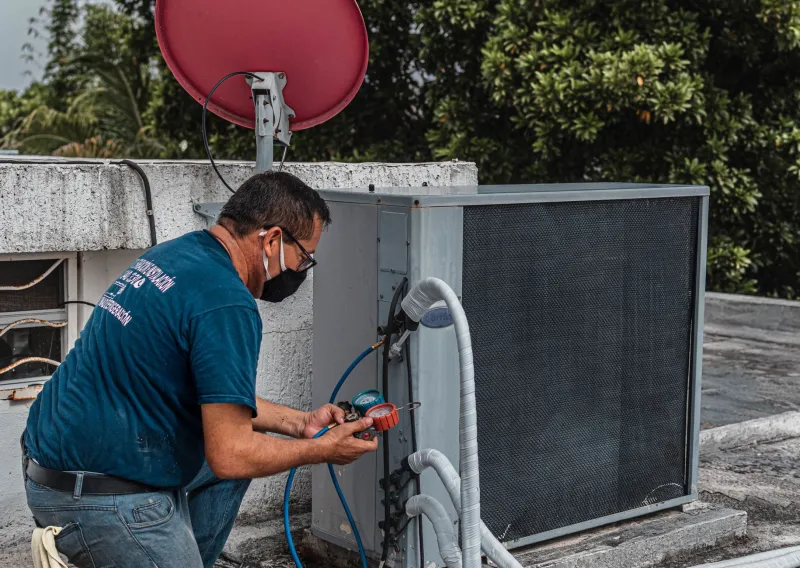
Refrigerant is the substance that allows your air conditioner to absorb heat from indoor air and release it outside. When refrigerant levels drop—whether due to a slow leak in the coils, a compromised fitting, or a connection that has worn over time—the system loses its ability to transfer heat effectively.
What happens next is predictable: the unit runs longer cycles trying to reach the thermostat's target temperature. It never quite catches up. The compressor, which is the most energy-intensive component in the entire system, works overtime. Your energy consumption climbs while your comfort level drops.
A refrigerant leak of even a modest size can increase cooling costs by 10 to 20 percent. In a home running a central system through a Texas or Florida summer, that translates to real money—often $50 to $150 per month in excess charges, depending on system size and local utility rates. Over an entire cooling season, the financial impact becomes substantial.
The tricky part is that refrigerant issues rarely announce themselves loudly. The air might still feel cool. The unit might still cycle on and off. A professional pressure test and refrigerant charge inspection are the only reliable ways to confirm whether levels are where they need to be.
Thermostat Calibration: When the Brain Gets It Wrong
Your thermostat is the command center for your entire cooling system. When it reads the indoor temperature accurately, it signals the system to run precisely as long as needed. When its calibration drifts—which happens gradually and often imperceptibly—it can cause the system to run far longer than the actual conditions require.
A thermostat that reads two degrees warmer than the actual room temperature will instruct the air conditioner to continue cooling well past the point of comfort. You may not feel noticeably colder, but the system is burning energy to chase a target that has already been met.
Older mechanical thermostats are particularly prone to calibration drift. Even some digital models can fall out of accuracy over time, especially if they are located near heat-generating appliances, in direct sunlight, or in poorly ventilated areas of the home or building. Recalibration or replacement is a straightforward fix—but only if the problem has been identified in the first place.
Dirty Ductwork: Resistance You're Paying For
Forced-air cooling systems depend on ductwork to distribute conditioned air throughout a building. When those ducts accumulate dust, debris, or biological growth—or when connections develop leaks—the system faces significant resistance and loss.
Leaky ducts are particularly costly. Studies from the U.S. Department of Energy have estimated that duct leakage can account for 20 to 30 percent of total cooling energy loss in a typical American home. That means nearly a third of the energy your system consumes may never reach the living spaces it is meant to cool. Instead, it dissipates into attics, crawl spaces, and wall cavities.
Beyond leaks, restricted airflow caused by accumulated debris forces the air handler to work harder to push conditioned air through the system. Filters clog faster, coils freeze more readily, and the entire system operates under unnecessary strain. Duct cleaning and sealing, performed by a qualified HVAC professional, can meaningfully reduce these losses and restore efficient airflow.
Compressor Strain: The Most Expensive Component Under Pressure
The compressor is the heart of your air conditioning system—and the most expensive single component to repair or replace. It is also the component most likely to bear the consequences of every other inefficiency in the system.
When refrigerant is low, the compressor compensates. When airflow is restricted, the compressor compensates. When the thermostat sends inaccurate signals, the compressor compensates. Over time, this accumulated strain leads to increased energy draw, reduced output, and accelerated wear.
A compressor operating under chronic stress may consume 15 to 25 percent more electricity than a properly supported unit delivering the same cooling capacity. More critically, the long-term mechanical wear shortens the compressor's service life—turning what might have been a $300 repair into a $1,500 compressor replacement or a full system upgrade.
Catching the contributing issues early—the refrigerant imbalance, the dirty coils, the restricted airflow—is the most reliable way to protect the compressor and, by extension, the longevity of the entire system.
Aging Components and Efficiency Ratings
It is also worth acknowledging that efficiency naturally declines as systems age. An air conditioner that was rated at a Seasonal Energy Efficiency Ratio (SEER) of 14 when it was installed a decade ago may be performing closer to a SEER of 10 or 11 today, depending on how well it has been maintained and what components have worn.
Modern systems are available with SEER ratings of 18, 20, or higher. For a property owner running an aging, underperforming unit, the energy savings from an upgrade can be significant enough to meaningfully offset the cost of replacement over several years. A qualified technician can provide a realistic assessment of where your current system stands and what the economics of replacement versus continued maintenance look like.
What a Professional Inspection Actually Catches
Many of the inefficiencies described above are not visible during a casual walk-through. Refrigerant pressure requires gauges. Thermostat calibration requires measurement. Duct leakage requires pressure testing. Compressor performance requires electrical diagnostics.
This is why a thorough professional inspection—not a quick filter swap—is the tool that actually identifies where money is being lost. At AC Service Pro, our technicians are trained to evaluate the full picture of system performance, not just the obvious surface-level concerns. We check refrigerant charge, test thermostat accuracy, assess airflow, inspect electrical components, and evaluate overall system efficiency against manufacturer specifications.
The goal is not simply to keep your system running. It is to keep it running at the level of efficiency you are already paying for.
The Bottom Line
An air conditioner that seems to be working is not necessarily an air conditioner that is working well. The gap between those two conditions is where energy waste lives—and where your utility bills quietly inflate month after month.
If your cooling costs have crept upward without a clear explanation, or if it has been more than a year since your system received a comprehensive inspection, the time to act is before the problem deepens. Contact AC Service Pro to schedule a full system evaluation. The savings you recover may be more significant than you expect.