7 Pre-Season AC Maintenance Tasks That Keep Your System Ready for Summer
Spring arrives quietly, but summer does not. Once temperatures begin climbing toward the upper eighties and beyond, your air conditioning system transitions from an occasional convenience to an around-the-clock necessity. That transition is precisely where unprepared systems fail — and where preventable repair bills are born.
At AC Service Pro, we consistently find that the customers who avoid expensive emergency calls are the ones who treat spring as a preparation season rather than a waiting period. The following seven tasks represent the core of a sound pre-season maintenance routine. Some can be monitored by the property owner; others require the hands and instruments of a licensed HVAC professional.
1. Replace or Clean the Air Filter
This is the simplest task on the list and, arguably, the one most frequently neglected. A clogged or saturated filter restricts airflow through the entire system, forcing the blower motor to work harder and reducing the efficiency of every other component downstream.
For most residential systems, filters should be replaced every one to three months during active use. Before the cooling season begins, install a fresh filter regardless of when the last replacement occurred. For commercial properties with higher occupancy or industrial environments, consult your service provider about filter ratings and replacement schedules appropriate to your specific building conditions.
2. Inspect and Clean the Outdoor Condenser Unit
The outdoor condenser unit spent the winter exposed to debris, moisture, and fluctuating temperatures. Leaves, dirt, grass clippings, and even small animal nesting materials can accumulate inside or around the cabinet, obstructing airflow across the condenser coils.
Begin by clearing a two-foot perimeter around the unit of any vegetation or stored items. A licensed technician should then inspect the coils for buildup and clean them using approved coil cleaner and low-pressure water. Bent condenser fins — the thin aluminum slats visible through the cabinet grille — can be carefully straightened with a fin comb to restore proper airflow. Never use a pressure washer on these components, as the force can cause irreversible damage.
3. Test the Thermostat for Accurate Calibration
A thermostat that reads two or three degrees above or below the actual room temperature will cause your system to cycle incorrectly, leading to either inadequate cooling or unnecessary energy consumption. Before peak season, switch your thermostat to cooling mode and verify that the system engages at the correct set point.
If you have an older mechanical thermostat, this is also an ideal time to consider upgrading to a programmable or smart model. The energy savings from precise scheduling and remote control can offset the upgrade cost within a single cooling season for many households.
4. Clear and Flush the Condensate Drain Line
As your air conditioner removes humidity from indoor air, it produces condensation that drains through a small PVC line, typically routed to a floor drain, utility sink, or exterior discharge point. Over time, algae, mold, and mineral deposits can partially or fully block this line, causing water to back up into the drain pan and potentially overflow onto ceilings, walls, or flooring.
A technician can clear the drain line using a wet-dry vacuum or a diluted bleach solution flushed through a cleanout port. Some systems also include a float switch that shuts the unit down when water reaches a dangerous level in the pan — verify that this safety feature is functional during your spring inspection.
5. Check Refrigerant Levels and Inspect for Leaks
Refrigerant is the chemical compound that makes cooling possible. It is not consumed during normal operation; if your system is low on refrigerant, there is a leak somewhere in the system. Running an air conditioner with insufficient refrigerant strains the compressor, reduces cooling capacity, and can ultimately destroy the most expensive single component in the system.
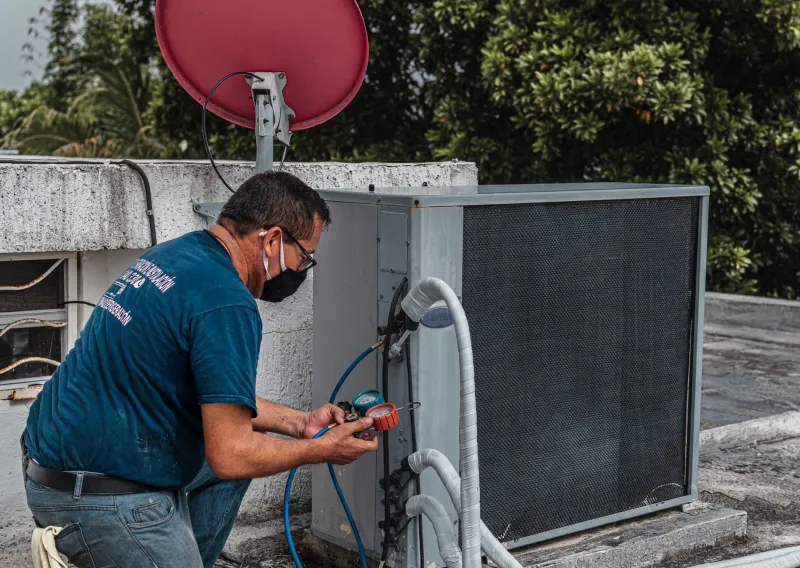
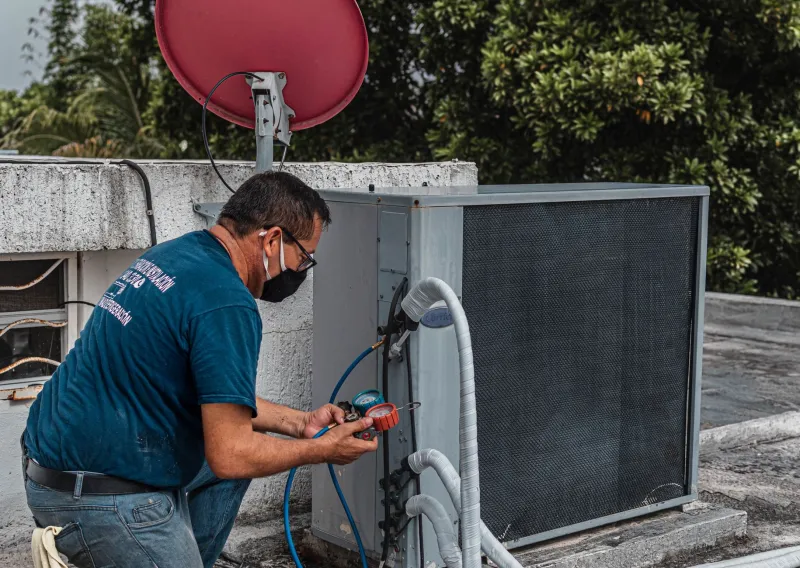
Refrigerant handling and charging require EPA Section 608 certification, so this is strictly a task for licensed professionals. During a spring tune-up, a technician will check operating pressures and inspect accessible refrigerant lines for signs of oil residue, which often indicates a leak point. Addressing a minor leak in spring is far less disruptive — and far less expensive — than a compressor failure in the middle of August.
6. Examine Electrical Connections and Capacitors
Electrical components within your AC system — including capacitors, contactors, and wiring connections — are subject to wear from heat cycling, vibration, and seasonal temperature swings. Loose connections generate resistance, which produces heat and can cause component failure or even pose a fire hazard.
During a professional inspection, a technician will tighten electrical connections, measure capacitor readings against manufacturer specifications, and look for signs of arcing or corrosion. Capacitors are relatively inexpensive to replace proactively; they become considerably more costly when their failure takes the compressor or fan motor down with them.
7. Verify Airflow Balance Across All Zones
Proper airflow distribution is essential for consistent comfort and efficient system operation. Before summer arrives, walk through your property and confirm that all supply and return vents are open, unobstructed by furniture, and delivering conditioned air as expected. In commercial environments, this may also involve checking damper positions in zoned systems.
If certain rooms are noticeably warmer or cooler than others despite a functioning system, the issue may lie in duct leakage, improper balancing, or insulation deficiencies — all of which a qualified technician can assess during a comprehensive inspection.
The Value of a Professional Tune-Up
While several of the tasks above involve visual checks a property owner can perform, a full pre-season inspection requires calibrated instruments, technical training, and familiarity with manufacturer specifications. An annual professional tune-up — ideally scheduled in March, April, or early May before appointment availability tightens — typically costs between $75 and $200 for a standard residential system.
Compared to the cost of an emergency service call, a replacement compressor, or a system that fails during a heat advisory, that investment is modest. At AC Service Pro, our seasonal maintenance visits are designed to identify problems while they are still small, giving our customers the confidence that their system is genuinely prepared for whatever summer brings.
Do not wait until the first hot week of June to discover your system needs attention. Schedule your spring tune-up now, and start the season with the assurance that your air conditioning is ready to perform.