How Smart Thermostats Are Transforming the Way Americans Cool Their Homes
For most of the twentieth century, controlling your home's temperature meant walking to a wall-mounted dial and adjusting it manually. Programmable thermostats brought scheduling capability in the 1980s and 1990s, but the interface remained static, the learning curve was steep, and many homeowners never moved beyond a single temperature setting. The result was enormous, largely invisible energy waste.
The smart thermostat changed that equation — and it did so not by asking homeowners to do more, but by doing more on their behalf. At AC Service Pro, we have watched this technology evolve from a novelty to a genuine cornerstone of modern HVAC efficiency. Here is what that evolution means for American households and businesses today.
What Separates a Smart Thermostat from Its Predecessors
The term "smart" in consumer technology is sometimes applied loosely. In the case of thermostats, however, it describes a meaningful set of capabilities that earlier devices simply could not replicate.
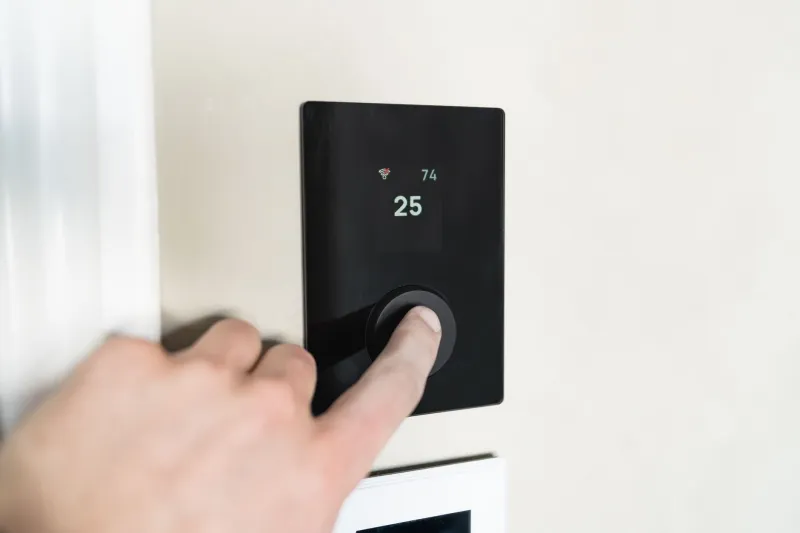
A smart thermostat connects to your home's Wi-Fi network, enabling control from a smartphone application regardless of your physical location. This alone addresses one of the most common sources of residential energy waste: the air conditioner running at full capacity in an empty house because the occupants forgot to adjust the temperature before leaving.
Beyond remote access, leading models from manufacturers such as Google Nest, Ecobee, and Honeywell Home incorporate adaptive learning algorithms. These systems observe your adjustment patterns over the course of one to two weeks and begin anticipating your preferences — lowering the temperature before you typically arrive home, for example, or easing back during hours when the house is consistently unoccupied. The result is a system that approximates the behavior of an attentive occupant without requiring any conscious effort from the user.
The Energy Savings: What the Data Actually Shows
Marketing claims around energy savings are often exaggerated. The smart thermostat category, however, has accumulated a substantial body of independent research supporting real-world efficiency gains.
The U.S. Department of Energy estimates that homeowners can save approximately ten percent on heating and cooling costs for every eight-hour period per day the thermostat is set back seven to ten degrees from its normal setting. Smart thermostats automate this behavior consistently — something manual adjustment rarely achieves in practice.
Google's Nest thermostat, one of the earliest and most studied smart models, published independent research indicating average savings of ten to twelve percent on heating bills and fifteen percent on cooling bills among its user base. Ecobee has reported similar figures, with some users achieving savings above twenty percent in climates with pronounced seasonal temperature swings.
For a household spending $200 per month on cooling during a four-month summer season, even a conservative fifteen percent reduction represents $120 in annual savings — frequently enough to recover the cost of the device within its first year of use.
Integration with Modern HVAC Systems
Smart thermostats are not standalone devices; they are interfaces between the occupant and the HVAC system. Their effectiveness depends in part on compatibility with the equipment they control.
Most contemporary central air conditioning systems are compatible with leading smart thermostat models, but compatibility is not universal. Older systems, multi-stage systems, or units using proprietary communication protocols may require verification before purchase. At AC Service Pro, we recommend confirming compatibility with a licensed technician prior to installation, both to ensure proper function and to avoid voiding manufacturer warranties.
Beyond basic on/off control, some smart thermostats communicate with variable-speed air handlers and two-stage compressors to optimize operation in ways that a conventional thermostat cannot. Rather than simply signaling the system to run at full capacity until the set point is reached, these integrations allow the equipment to modulate its output — running at lower capacity for longer periods, which improves humidity control and reduces energy spikes.
Occupancy Sensing and Geofencing: Precision Without Effort
Two features in particular have elevated the smart thermostat from a convenient gadget to a genuinely intelligent system: occupancy sensing and geofencing.
Occupancy sensors, built into select models or available as add-on room sensors, detect the presence of people within a defined area. When a home or specific zone is unoccupied, the thermostat can automatically shift to an energy-saving mode without relying on a preset schedule. This is particularly valuable for households with irregular routines — shift workers, families with variable school and activity schedules, or anyone whose daily pattern does not conform to a reliable timetable.
Geofencing uses the GPS location of registered smartphones to determine when occupants are approaching or leaving the property. When the last registered device departs beyond a defined radius, the thermostat transitions to an away mode. As devices return within range, the system begins pre-conditioning the space so that it reaches the desired temperature by the time occupants arrive. For households where people rarely think to adjust the thermostat before leaving, geofencing eliminates a persistent source of energy waste entirely.
Utility Rebates and Demand Response Programs
One financial dimension of smart thermostat adoption that many consumers overlook is the availability of utility rebates. Across the United States, dozens of electric utilities offer rebates ranging from $25 to $100 or more for customers who install qualifying smart thermostat models. Some utilities provide the devices free of charge as part of demand response enrollment programs.
Demand response programs allow utilities to send brief adjustment signals to enrolled thermostats during periods of peak grid demand — typically the hottest afternoons of summer when electricity demand strains supply. Participating households receive bill credits or other incentives in exchange for allowing these temporary setbacks. In most cases, the temperature adjustment is minor and brief, and occupants retain the ability to override the signal if necessary.
Checking with your local utility before purchasing a smart thermostat is a worthwhile step. The combination of a rebate, demand response credits, and ongoing energy savings can make the return on investment considerably faster than the device's retail price alone would suggest.
What This Means for Your AC System
A smart thermostat does not replace proper air conditioning maintenance, nor does it compensate for an aging or undersized system. It is, however, one of the most cost-effective upgrades available to homeowners who want to extract greater efficiency and comfort from their existing equipment.
At AC Service Pro, we view smart thermostat installation as a natural complement to the maintenance and repair services we provide. A well-maintained system paired with intelligent temperature control performs closer to its rated efficiency specification — and delivers a noticeably more consistent indoor environment.
If you are considering a smart thermostat upgrade or have questions about compatibility with your current system, our technicians can assess your setup and recommend an appropriate solution. The technology has matured considerably, and for most households, the transition is more straightforward — and more rewarding — than many expect.